Key takeaways
Table of contents

Key takeaways
Table of contents
Water-miscible coolant is not a finished product that you fill once and forget. Water evaporates, coolant leaves the machine on chips and workpieces, foreign oil gets into the tank, and every refill changes the mixture. If you want to keep your values within target, coolant monitoring needs a fixed process.
A practical coolant monitoring process has four elements:
In this article, you will learn why the condition of your coolant keeps changing, how to check the most important values correctly, which mistakes happen most often, and how to automate manual measurement step by step.
Coolant has three main jobs in machining: it lubricates and reduces friction between tool and workpiece, it cools and carries heat away, and it flushes chips out of the work area. It also has to protect against corrosion, be compatible with machines and skin, and comply with local chemicals legislation. Low foaming is a basic requirement.
An emulsion can only do all of this if its composition is right. And that composition keeps changing in daily production:
When concentration moves outside its target range, the consequences are concrete: unnecessary consumption, foam, odor, skin irritation, increased tool wear, and corrosion on machines and workpieces. These problems rarely appear overnight. They build up slowly and, without regular checks, only become visible once scrap or downtime has already happened.
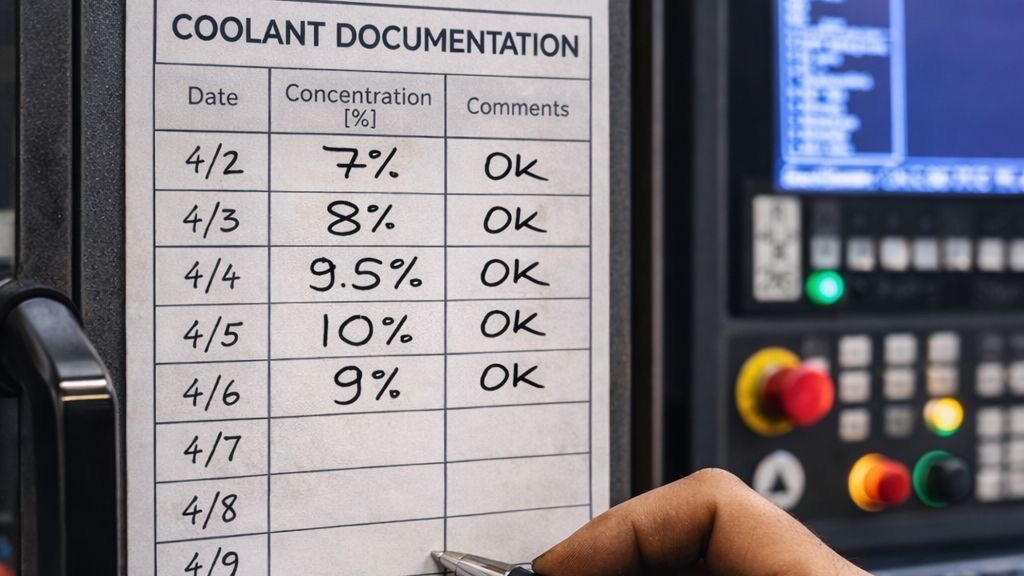
In Germany, testing is also mandatory: the Technical Rule for Hazardous Substances TRGS 611 requires water-miscible coolants to be tested and documented regularly, including at least weekly checks of concentration, pH and nitrite. In Switzerland and Austria, too, the coolant manufacturer's specifications and clean documentation are part of the state of the art.
Concentration is the most important control value of an emulsion. It influences lubrication, cooling performance, corrosion protection, foaming behavior and residues. In machining, the optimal concentration is usually between 7% and 12%, depending on the operation, material and product. A good concentration alone is not enough, however: coolant care matters too. Define the binding target range for each machine, based on your coolant manufacturer's data sheet.
In daily practice, concentration is measured with a handheld refractometer. The next section shows how this works step by step.
The pH value shows whether an emulsion is starting to break down. If it falls clearly below the range specified by the manufacturer, this often points to bacterial growth, a concentration that is too low, or chemical contamination. A value that is too high can indicate overconcentration or incorrect additives.
pH is checked with test strips or a calibrated meter. Test strips are fast and suitable for the shop floor, but reading the color fields is a matter of interpretation. In MANAGER, you can photograph the test strip instead: the AI-based strip analysis reads pH, hardness and nitrite from the photo and saves the result with date, time and user directly on the correct machine.
In practice, temperature is rarely measured. It matters mainly where tolerances are tight: coolant temperature affects the dimensional accuracy of your workpieces and the behavior of the emulsion. If the temperature deviates, the result can be scrap or waiting time until the coolant returns to room temperature. Rising temperatures can point to insufficient tank volume, high continuous load or a cooling problem. Where temperature is relevant, define the permitted range together with your coolant supplier instead of using one general limit for all machines.
Tank level changes faster than many people expect due to evaporation, carry-out and production volume. If the tank runs empty, the machine stops. But the goal is not simply a full tank: refilling with pure water or an incorrectly mixed emulsion shifts the concentration. Tank level and concentration should therefore always be considered together. Measure first, then refill with the right mixture.
In addition to the four values, a quick look at the condition of the emulsion is worthwhile at every check: unusual color or odor, foam, floating foreign oil or visible deposits can be spotted without any measuring device and often earlier than any measurement.
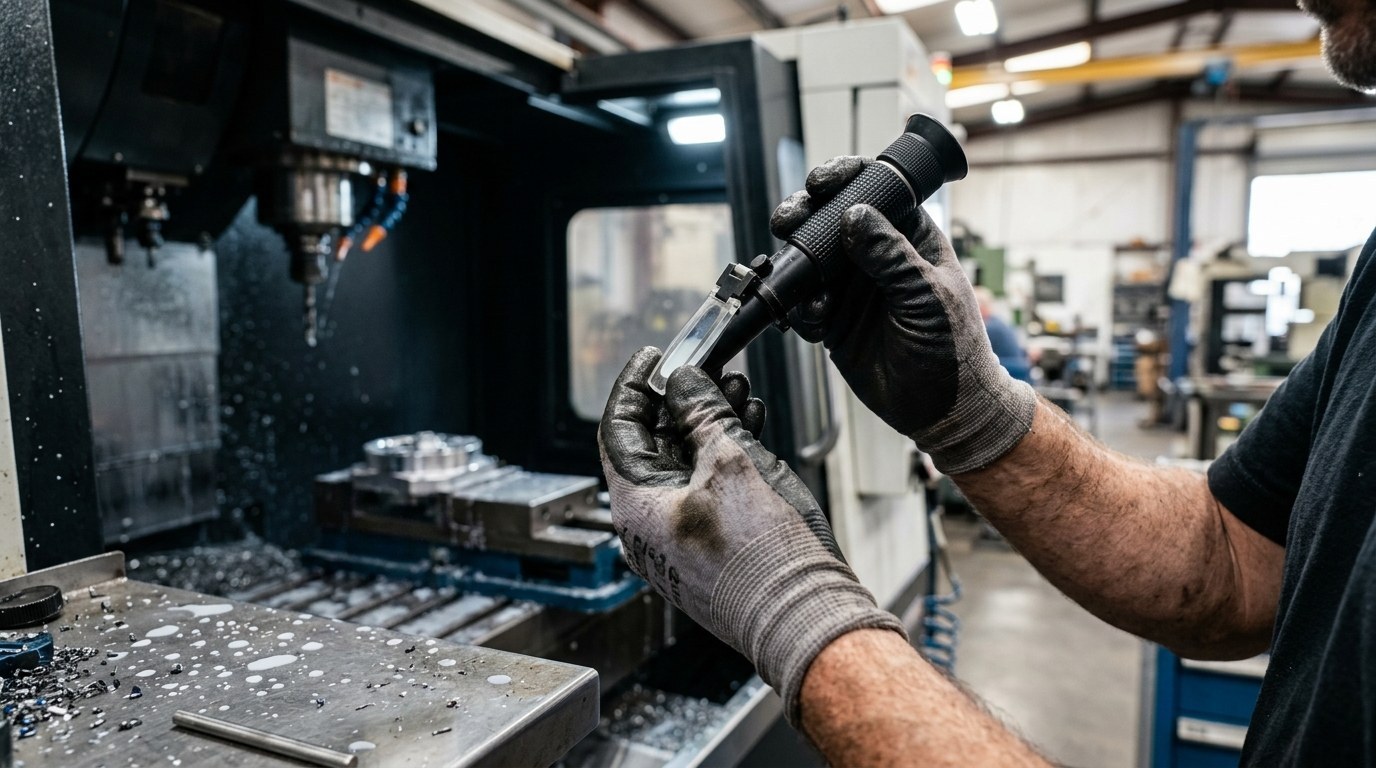
The handheld refractometer is the standard tool for checking coolant concentration. Here is how to do it:
An example: if the refractometer shows 6.0 Brix and the factor specified by the manufacturer is 1.5, the actual concentration is 9.0%.
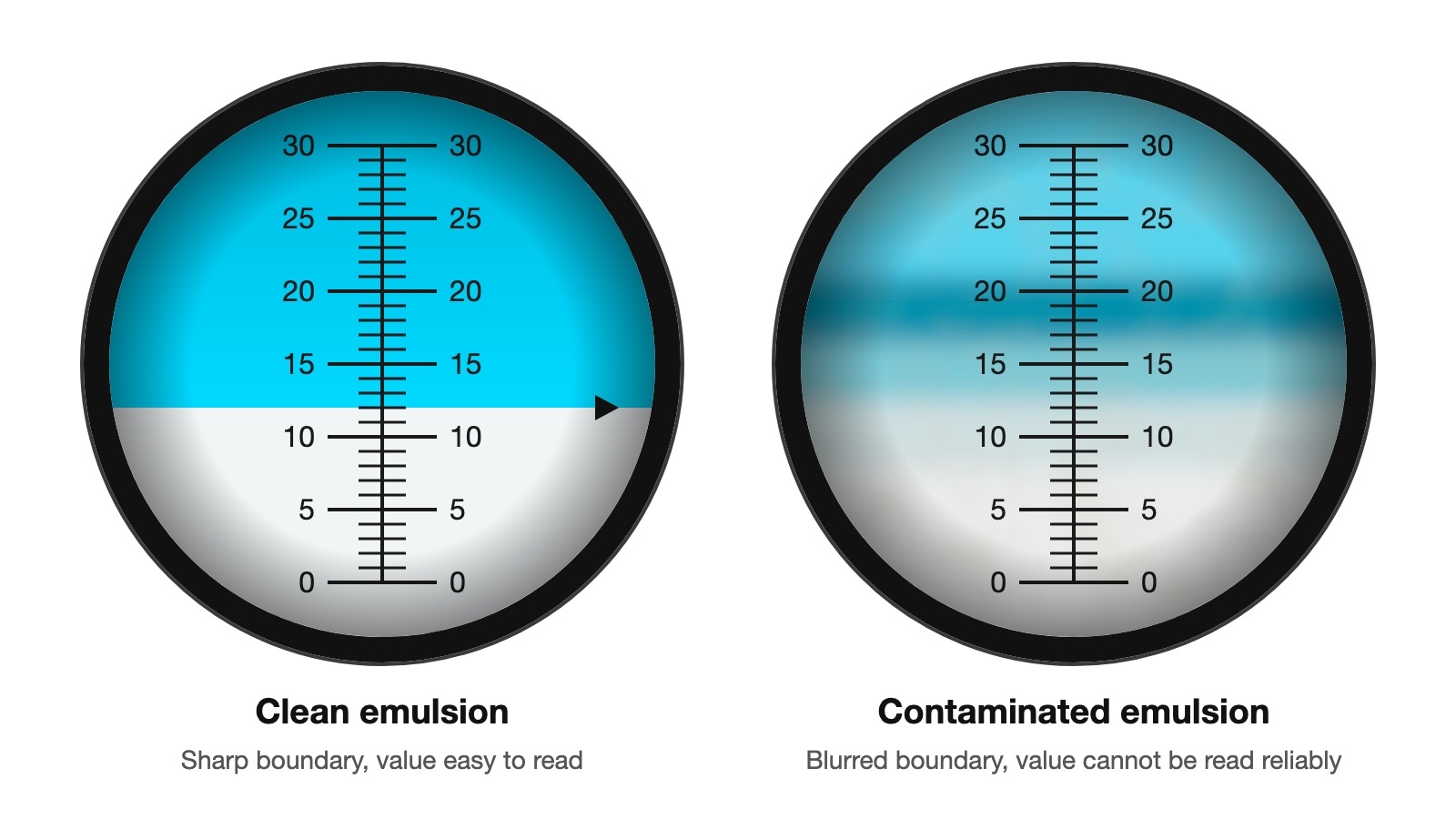
Good to know: with a contaminated emulsion, the light-dark boundary becomes blurred and the reading inaccurate. This is not just a measurement problem but a warning sign that foreign oil or contamination has built up in the system. You can find more about manual measurement and its documentation on our manual measurement page.
Most concentration problems are not caused by poor products but by avoidable mistakes during checks:
How often you should check your coolant depends on the operation, carry-out and machine utilization. As a rule of thumb, we recommend measuring concentration before every shift, and even more often for operations with high carry-out. This structure has proven effective:
A good monitoring process also works during a normal shift with a full order book. If it only runs as long as one experienced person remembers everything, it is not yet a stable process.
A manual measurement per shift and machine takes time, and time is what production lacks most. In practice, measurements are therefore often taken less frequently than planned, and concentration drifts out of its target range unnoticed.
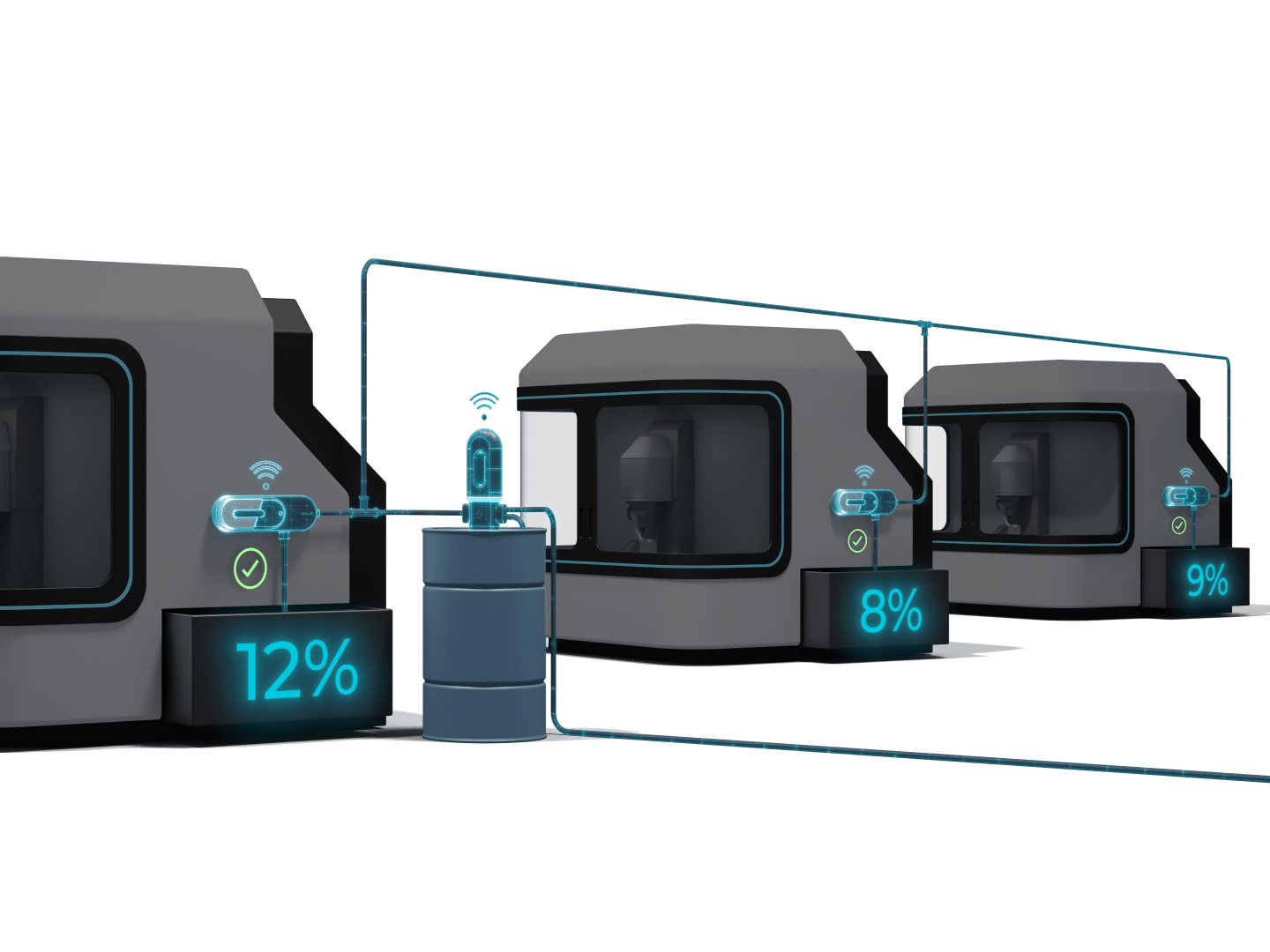
This is where AUTOPILOT from Liquidtool comes in. The SENSOR measures concentration and temperature and checks tank level several times per day, far more often than any manual routine. The values come together in MANAGER, where you define target ranges, rules and notifications. If a value deviates, you see it immediately instead of discovering it on the next round.
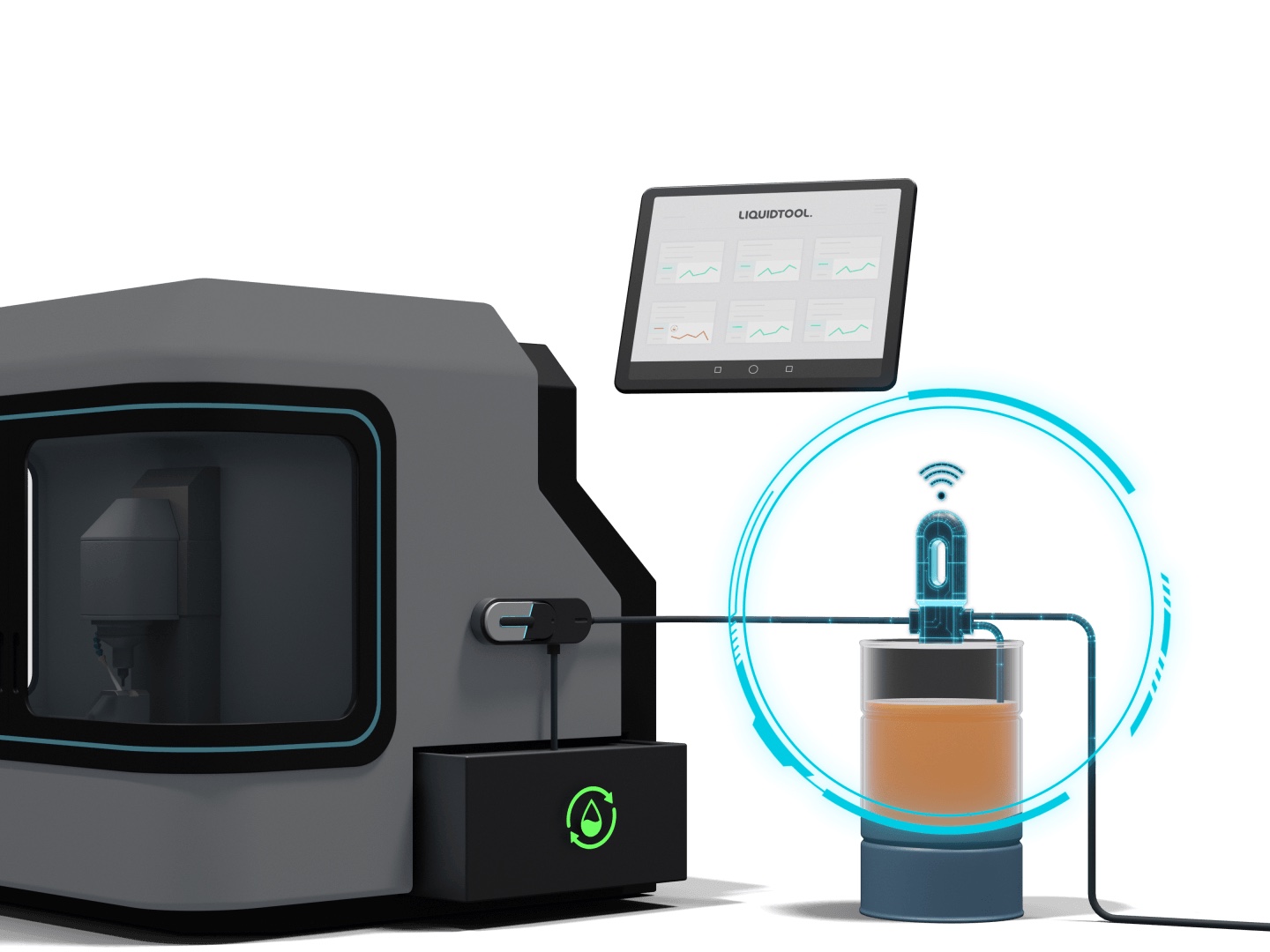
The SMARTFILLER closes the loop: it mixes coolant at the right ratio and automatically refills it directly into the tank of the CNC machine. Measuring, deciding, refilling and documenting become one continuous process without manual steps in between.
This completely eliminates manual measurement of concentration, temperature and tank level. pH is not measured automatically: test strips remain part of your check plan, but with the AI-based strip analysis in MANAGER, you can document them in seconds instead of minutes. The complete history per machine stays in one place, from manual measurements to automatically captured sensor values.
Coolant monitoring means more than occasionally holding a refractometer up to the light. It takes defined target values, measurements of concentration, pH and tank level, and temperature where needed, fixed intervals, clear responsibilities, and documentation that makes trends visible.
There are two ways to do this: either you apply this process consistently by hand, with a refractometer, test strips and clean documentation. Or you automate it with AUTOPILOT: the SENSOR measures, the SMARTFILLER refills, and the only value you still check by hand is pH.
Learn more about AUTOPILOT or request a demo directly.

Frequently asked questions