Key takeaways
Table of contents
Key takeaways
Table of contents
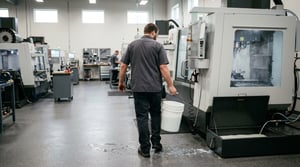
Refilling coolant by hand only takes a few minutes per machine. With many machines, it adds up. In a Liquidtool customer shop with 9 CNC machines, refilling took around 1 hour per day before automation. On top of that come costs you do not see right away. This article explains where they come from, how automatic coolant refill works and when it pays off.
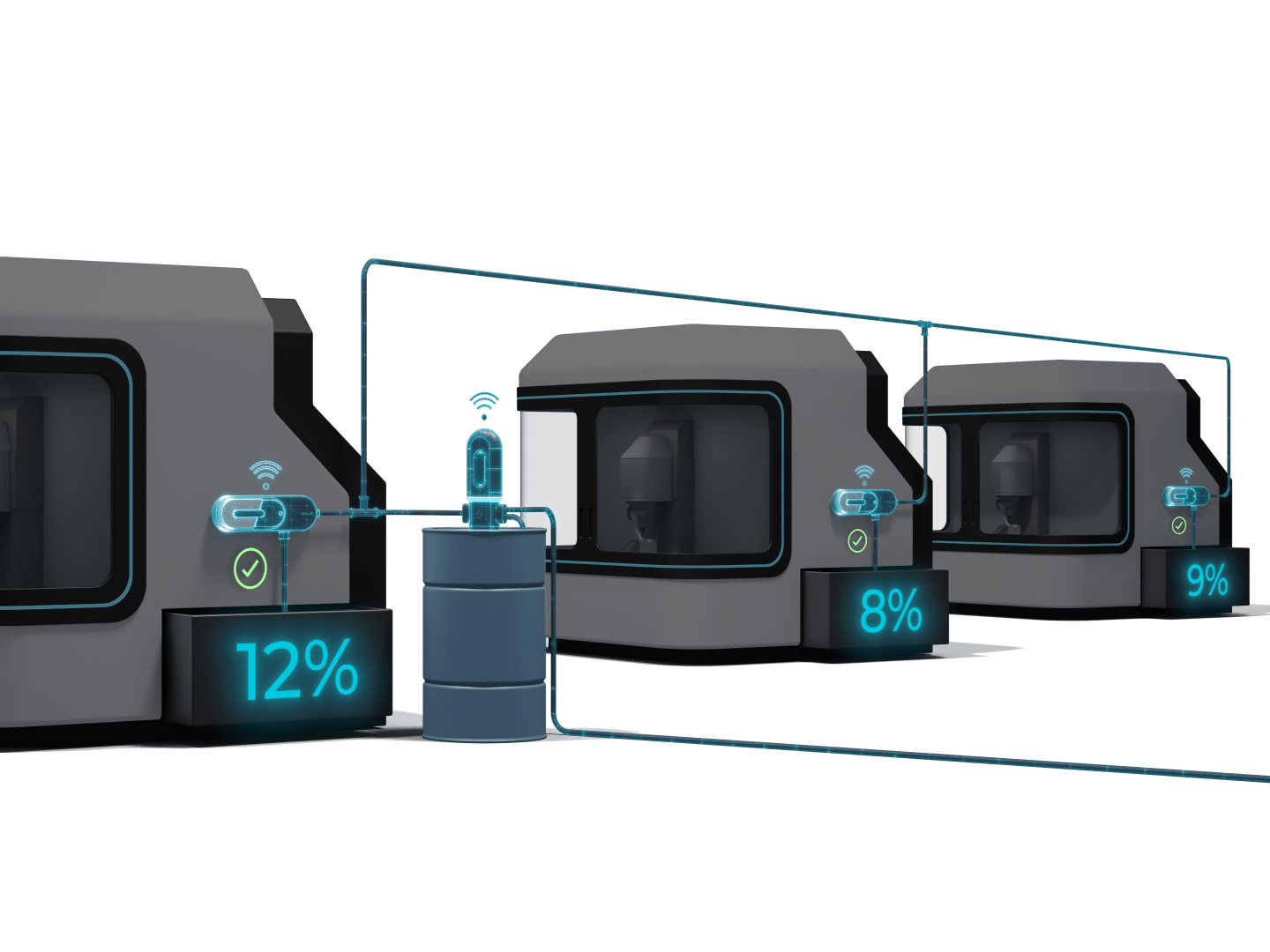
With automatic coolant refill, a system takes over the work that someone would otherwise do by hand. A sensor at the machine measures how full the tank is and how high the concentration is. When coolant is missing, a dosing unit mixes water and concentrate in the right ratio and refills the tank. You no longer have to measure, mix and carry buckets every time you refill.
Water-miscible coolant is mostly water. The concentrate usually makes up 7 to 12%. During production, the tank keeps losing fluid in two ways:
How much water and how much concentrate is lost differs from machine to machine and from day to day. If you always refill at the target concentration, you also add concentrate for the water that has evaporated. Over time, the concentration gets too high. But refilling with plain water is never right: it does not replace the concentrate that sticks to chips and parts. The refill mix therefore always needs concentrate, at least 0.5%. A measurement before every refill shows how high its concentration needs to be. Our guide to coolant monitoring explains how to measure.
Labor time is the obvious part. Additional costs come from wrong concentrations, temperature jumps or overflowing tanks. Figures from Liquidtool customer shops show this.
If the concentration is too high, you use more concentrate than you need. In one Liquidtool customer shop, the coolant also left sticky oil residue on the machine and its windows. If a tank overflows, mixed coolant is lost as well. If you keep the concentration under control, you need less concentrate. In one Liquidtool customer shop, concentrate costs even fell by half after automation.
The concentrate is formulated to protect the coolant against bacteria and fungi. If the concentration stays too low, this protection is no longer enough. Germs multiply, the pH drops and the coolant starts to smell. Then it has to be replaced sooner. In one Liquidtool customer shop, the coolant has lasted twice as long since automation, 2 years instead of 1. Every change causes costs for concentrate, disposal and cleaning. On top of that comes machine downtime.
If the concentration is too low, the coolant lubricates less well and tools wear faster. If it keeps changing, cutting conditions also change from day to day. In one Liquidtool customer shop, tools for a stainless steel part have lasted around 20% longer since automation, and scrap has fallen from 6% to below 2%.
If you add a lot of cold coolant at once, the tank cools down sharply. Part and machine cool down with it and change their dimensions slightly. With tight tolerances, that is enough to matter. In one Liquidtool customer shop, the tank temperature dropped from 25 °C to 15 °C during refilling. This directly affected the dimensional accuracy of parts within a batch, and corrections were needed until the tank temperature was even again.
If you fill by eye, you risk an overflowing tank. Before automation, one Liquidtool customer shop had an overflow once or twice a year and had to do a major cleanup each time. And if you mix and carry coolant by hand, it easily gets on your skin. The Institute for Occupational Safety and Health of the German Social Accident Insurance (IFA) calls avoiding constant skin contact with coolant the first rule of skin protection, among other things through automated systems (IFA, skin protection).
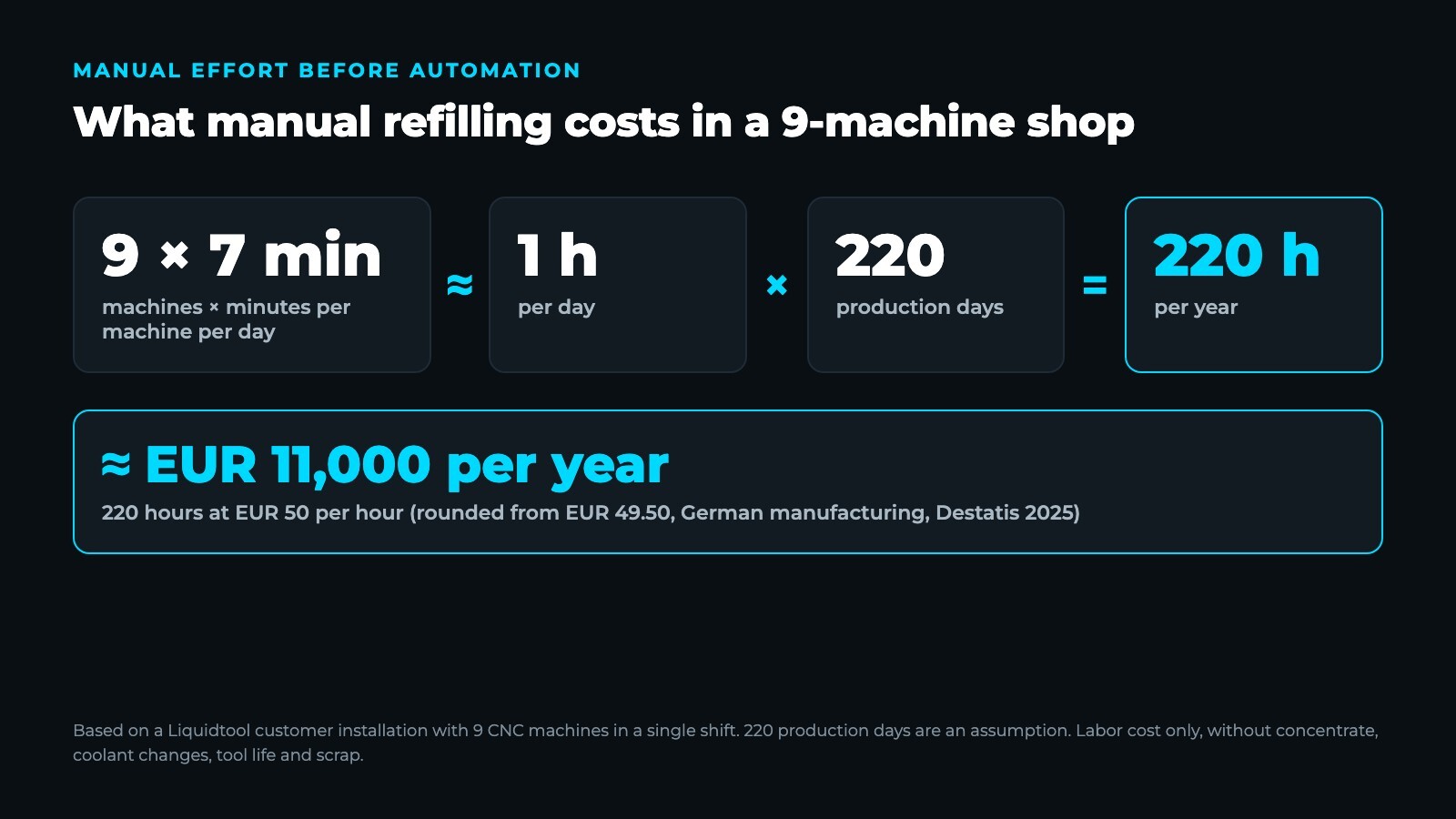
In the Liquidtool customer shop with 9 CNC machines from the introduction, every machine was refilled by hand each morning before automation, without measuring the concentration first. This took around 7 minutes per machine. According to the shop's success story, this work is no longer needed today. This is how the labor cost adds up:
| Item | Calculation | Result |
|---|---|---|
| Time per day | 9 machines × 7 minutes | about 1 hour |
| Time per year | 1 hour × 220 production days | 220 hours |
| Labor cost per year | 220 hours × EUR 50 | EUR 11,000 |
The 220 production days are an assumption. EUR 50 per hour is rounded from the average labor cost in German manufacturing in 2025 (EUR 49.50, Destatis). Not included is what the shop gained in addition after automation: the coolant lasts twice as long, and tools last 15 to 20% longer.
For your shop, calculate: number of machines × minutes per machine per day × production days ÷ 60 × hourly rate.
Some shops use a mixer at the drum. It always mixes water and concentrate at the set ratio. You still have to measure the concentration, work out what each machine needs and fill in the coolant yourself. Because a different amount of water evaporates in every tank, each machine needs a different refill mix. You would have to readjust the mixer every time. An automatic system, by contrast, measures first and refills each machine so that it keeps its target concentration.
AUTOPILOT is Liquidtool's coolant automation for CNC machines. The system measures, mixes and refills automatically. It consists of two devices and is controlled with the MANAGER software:
One SMARTFILLER supplies several machines through piping. In MANAGER, you set a separate target concentration for each machine, for example depending on material or machining. AUTOPILOT measures and refills several times a day, always only as much as needed. Because only a small amount is added each time, concentration and temperature stay stable.
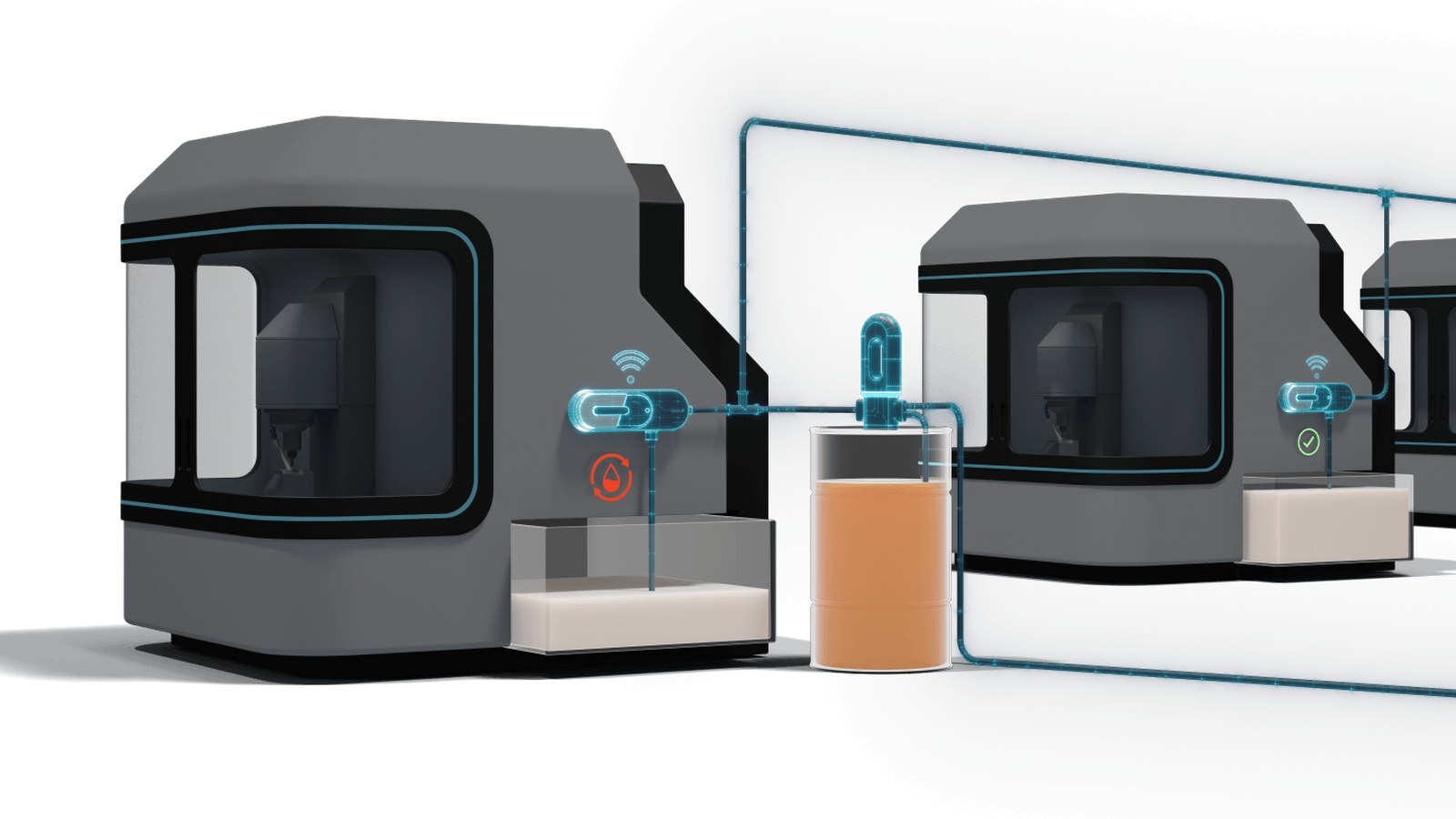
Several safeguards prevent a tank from overflowing: fill limits, a daily volume limit, monitoring of the coolant filled in and a double level measurement (hydrostatic and ultrasonic). If needed, you can still fill the tank by hand at any time. AUTOPILOT does not measure pH. You still check it separately.
Above all in these cases:
You do not have to switch all machines at once. Several Liquidtool customers started with one machine and then equipped more step by step, see our success stories. You can test AUTOPILOT on your own machines for 90 days, and you will find the prices on the pricing page. Request a demo and we will show you how AUTOPILOT works on your machines.

Frequently asked questions